
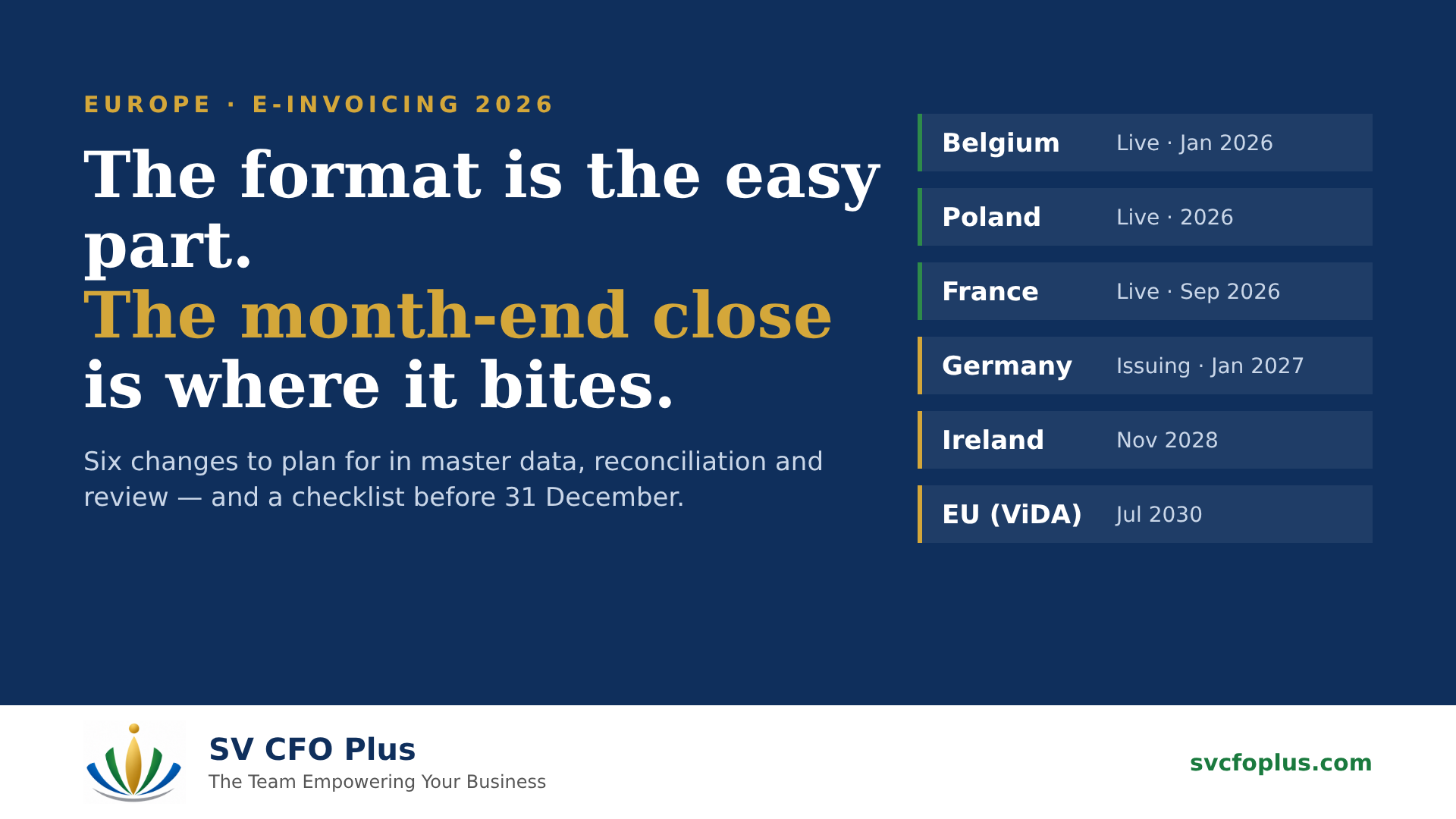
2026 is the year structured e-invoicing stopped being a project plan in Europe and became day-to-day reality.
- Belgium: domestic B2B e-invoicing via Peppol has been mandatory since 1 January 2026.
- Poland: KSeF became mandatory for large taxpayers in February 2026 and for most other VAT-registered businesses from April.
- France: since 1 September 2026, every French-established business must be able to receive e-invoices, and large and mid-sized companies must issue them and e-report. SMEs follow from September 2027. The tax authority has said it will take a soft approach to enforcement during 2026.
- Germany: businesses have had to be able to receive e-invoices since January 2025. Issuing is currently scheduled to become mandatory from 1 January 2027 for businesses with prior-year turnover above EUR 800,000, and for everyone from 2028.
- Ireland: Revenue has set November 2028 for large corporates to issue e-invoices, with every business required to be able to receive them from the same date.
- EU-wide: ViDA brings structured e-invoicing to intra-EU B2B trade from July 2030.
Most of the commentary so far has been about formats, platforms and deadlines. That is the IT conversation, and it matters.
But for accounting practices and finance teams, the more useful question is a different one:
What happens to the month-end close when invoices start arriving as structured data instead of PDFs?
Here is what we see.
1. Master data becomes the bottleneck
A PDF invoice with a slightly wrong customer address still gets paid. A structured e-invoice with a missing or wrong identifier may not be delivered at all.
VAT numbers, company registration identifiers, routing addresses and legal names on customer and supplier records now have to be correct, not "close enough". In most ledgers we look at, the supplier and customer master files have never been cleaned. They have simply grown.
Action: review the top 50 customers and top 50 suppliers by value first. That usually covers most of the invoice volume.
2. "Sent" and "received" are no longer the same thing
Under the new regimes, an invoice has a status outside your ledger: issued, delivered, rejected, accepted. A sales invoice that sits in the ledger but was rejected by the platform is a receivable that the customer may never have seen.
Action: add one step to the close: reconcile invoices issued in the ledger against invoices delivered on the platform, and clear rejections before the period is locked.
3. Automation makes errors arrive faster, not disappear
Structured data is excellent for automated posting. It also means a wrong default VAT code or a wrong nominal mapping can post hundreds of lines before anyone looks.
Action: keep a human review on the first months of automated postings, and sample the suspense and "uncategorised" accounts every month. A suspense balance that grows each month is the earliest warning sign.
4. The AP inbox changes shape
Purchase invoices will increasingly come through the platform or the accounting software rather than a shared mailbox. During the transition, most businesses will run both: some suppliers on e-invoices, some still on PDF and paper.
Action: decide who owns each channel, and make sure nothing falls between them at month-end. Two inboxes with no clear owner is how accruals go missing.
5. Credit notes and corrections need a process
In a structured regime you cannot quietly re-issue an amended PDF. Corrections generally need a proper credit note and a new invoice, and both must flow through the same route.
Action: write down the correction procedure now, before the first dispute, not after.
6. Cross-border clients feel it first
Practices with clients selling into Belgium, France or Germany are already fielding questions, even when the client itself is based elsewhere. Receiving obligations often apply well before issuing obligations do, which catches smaller businesses off guard.
Action: list which of your clients trade into these markets and what each one needs to be able to receive today.
The capacity problem nobody budgeted for
None of this is technically difficult. It is just a lot of careful, unglamorous work: cleaning master data, mapping VAT codes, adding a reconciliation step, re-documenting the close.
For a practice, that work lands in Q4, which is already the busiest stretch before year-end. For an SME finance team, it lands on the same two or three people who already run the close.
This is where we think a well-run extended team is genuinely useful: master-data clean-up, platform-to-ledger reconciliation and close documentation are well defined, checkable tasks. The practice keeps the client relationship and the final review; the extra capacity handles the volume.
A short checklist before 31 December 2026
- Clean the top 50 customer and supplier records: VAT numbers, registration identifiers, legal names.
- Confirm every client or entity can receive e-invoices where it is already required.
- Map VAT codes and default nominal codes for automated posting, and test them on real invoices.
- Add a "ledger vs platform" reconciliation to the month-end checklist.
- Write the credit-note and correction procedure.
- Agree who reviews automated postings, and how often, for the first three months.
This article is about finance operations. It is not tax or legal advice, and the dates above are based on publicly announced timetables as of early October 2026, which can change. Please confirm the position for each country with a local adviser.
SV CFO Plus supports accounting practices and growing businesses with accounting, month-end close, MIS and virtual CFO support, with senior review on every deliverable.
Question for practice owners and finance leads in Europe: what has been the hardest part so far – the software, the data, or the time?
Related: Outsourced accounting support for Ireland, the Netherlands, Belgium and Europe · White-label support for accounting firms